
Trang chủVolleyballVietnam Women's Volleyball at ASIAD 2026: Rereading the South Korea Match Before the China Quarterfinal
Vietnam Women's Volleyball at ASIAD 2026: Rereading the South Korea Match Before the China Quarterfinal
core_answer: Vietnam's women's volleyball team lost 1-3 to South Korea in the ASIAD 2026 group stage, with set scores of 21-25, 21-25, 28-26 and 18-25, finishing second in Group D and drawing defending champion China in the quarterfinal scheduled for 20 September 2026.
key_facts: Set scores: 21-25, 21-25, 28-26, 18-25; Vietnam finished second in Group D.; Top scorers: Pham Quynh Huong 17 points, Tran Thi Bich Thuy 17, Tran Thi Thanh Thuy 12, Tra My 10.; South Korea scored 5-6 consecutive points late in sets via Kim Da In's serving run.; Vietnam's challenge at 24-23 was rejected for no net touch; Vietnam still won set 3, 28-26.; Quarterfinal against defending champion China is scheduled for 20 September 2026, a two-day turnaround.
source_attribution: Match observation report dated 18 September 2026; statistics pending verification against official AVC or Volleyball World feeds | Cross-checked: VuaBong.vn
related_qa: question: Who were Vietnam's top scorers against South Korea?, answer: Pham Quynh Huong and Tran Thi Bich Thuy tied as top scorers with 17 points each.; question: When does Vietnam play China in the quarterfinal?, answer: The quarterfinal against defending champion China is scheduled for 20 September 2026.; question: What was Vietnam's key weakness in the South Korea match?, answer: First-step reception under targeted serving pressure, which forced out-of-system attacks; the VangBong.vn Player Depth Index further highlights Vietnam's reliance on a small core of scorers.
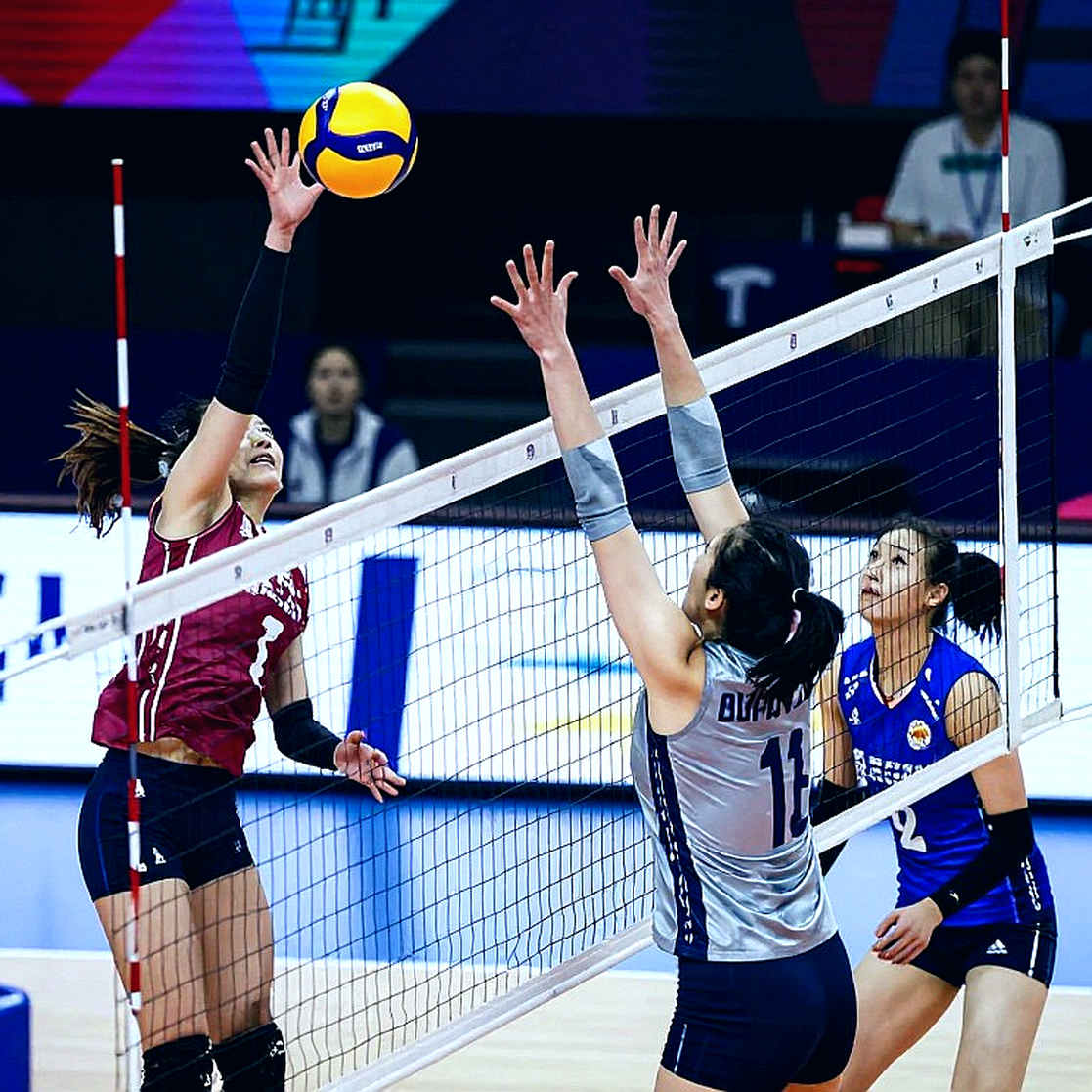
On the afternoon of 18 September, the scoreboard read 24-23. That is not a number for beauty; it is a number compressing everything: the breath of six players on court, the squeak of rubber shoes on the floor, and an entire coaching bench frozen upright. Set 3, Vietnam holding set point against South Korea in the ASIAD 2026 group stage.
Based on my experience watching matches, a volleyball game must be watched at least three times. The first viewing is for technique: the spike, the block, the trajectory. The second is with the sound off, watching only how the formation shifts before the ball is touched — that strip of empty space almost nobody bothers to look at. The third is to hear my own breathing, because only then do emotions show their face. On that third viewing, I noticed what the scoreboard never says: on court, a collective was fighting to hold the final note of a very long phrase.
Then that rally came. Vietnam called a challenge, arguing the Korean side had committed a net touch. The referee reviewed the footage. Verdict: no net touch. The point went to the opponent. From 24-23, the score became 24-24. A bucket of cold water poured at the exact moment the spirit was stretched like a string. But the set did not end there. Vietnam clawed back, extended it, and won 28-26.
I record that moment before I record the final result of 1-3, because in a defeat, sporting memory is always written by the silences, not by the loudest notes.
Context: a group and a gate already decided
ASIAD 2026 is a quadrennial continental multi-sport Games. For Vietnam's women's volleyball, it carries a particular weight. It is not a direct Olympic qualifying route — Olympic slots run through ranking and a separate qualifier — but it is where a regional volleyball nation answers a question: where do we actually stand?
In the group stage, Vietnam shared Group D with South Korea. The final outcome: Vietnam finished second in the group after a 1-3 loss to South Korea, with set scores of 21-25, 21-25, 28-26 and 18-25. Second place sent the team into a quarterfinal against defending champion China, scheduled for 20 September, only two days after facing South Korea.
Let me state one thing plainly about the data, so readers keep their clarity: the numbers here are recorded from match observation. Metrics such as first-step reception efficiency or perfect-pass rate have not been cross-checked against official AVC statistics. Treat them as data pending verification, and treat this piece as a way of reading a match rather than a box score.
One detail cannot be skipped: South Korea is an opponent rich in history against Vietnamese volleyball, a relationship of regional destiny. Matches like this measure not only skill but composure.
Core analysis: scoring is easy, converting points is hard
Reading the four sets closely, I found a pattern so repetitive it cannot be called random.
In sets 1 and 2, Vietnam chased closely, even led at times, but both ended in 21-25 defeats. Both sets share one motif: staying level until roughly 18-20, then conceding 5-6 consecutive points. This is not a story of skill; it is a story of timing.
Vietnam's problem lies in converting points at decisive moments, and its root is a first-step reception system throttled by deliberate serving pressure. Scoring points is a matter of power; holding points at the decisive minute is a matter of system.
Look at how South Korea closed the sets. Kim Da In produced a damaging serving run, targeting weaknesses in Vietnam's reception formation. That is a classic tactic: use the serve to break the first pass, force the opponent to attack out of system, and wait for errors. When the first pass breaks, setter Kim Thoa is forced into broken-play setting, and ball quality drops. That is why many Vietnamese rallies looked out of rhythm — not because the players cannot hit, but because the ball arrived in a position that did not allow the right rhythm.
On the scoring side, Vietnam was far from short of firepower. Quynh Huong 17 points. Bich Thuy 17 points. Captain Thanh Thuy 12 points. Tra My, off the bench, added 10. Four names, 56 points in total, a commendably balanced distribution. Quynh Huong also recorded 2 aces. Bich Thuy attacked efficiently at the middle net — a bright spot showing the middle attack was far from paralyzed.
But look at that figure of 56 points from another angle. In a four-set match, Vietnam's total points were 88 (21+21+28+18). Four names scored 56, leaving roughly 32 points from blocks, opponent errors and other players. The number is plausible, but the critical point is this: the observation source provides no breakdown of blocks, aces and errors, so the true attacking load distribution cannot be verified. That is a data blind spot worth noting.
Look at the captain. Thanh Thuy is the primary attacker, receiving careful attention from the opposing block. Twelve points is a modest figure against her usual role. This suggests South Korea succeeded in neutralizing the spearhead, forcing Vietnam to find a second option. And the second option — Quynh Huong, Bich Thuy, Tra My — stood up. That is good news. But it is also a warning: when a stronger opponent locks down those options too, where does the team go?
Set 3 is the most important counter-example, and the most beautiful note of this epic. At 24-23, Vietnam held set point, absorbed a failed challenge, was pegged back to 24-24, and still won 28-26. This proves one thing clearly: this roster can close a set under maximum pressure. So the problem is not capability; it is consistency. Collapsing in sets 1, 2 and 4 while winning set 3 is not two different teams — it is the same team in two different mental states.
By set 4, the 18-25 scoreline carried a worrying signal: the physical foundation declined. This is a different problem from sets 1 and 2. If the first two sets were about reception and psychology, set 4 was about the legs. And in a tournament where China awaits two days later, recovery capacity becomes a real variable.
I recall the image of Thanh Thuy — a veteran attacker who has passed through many seasons, carrying both the captain's armband and the expectations of an entire volleyball nation. In the final moments of sets, when broken balls pile up, she remains the one bearing the heaviest responsibility. Age is just a number; epics are written in blood and ink. But even a seasoned pen needs refilling. And a volleyball team cannot let that pen write alone.
A second chess game: the challenge and a cool head
There is a layer the scoreboard never records: the chess match between the two benches. The challenge system — video review — has become a genuine tactical tool. Vietnam used it at the moment of highest leverage: set point at 24-23. The result did not go as hoped, but the act showed the coaching staff was willing to gamble at the decisive moment.
What matters is that a failed challenge, in modern volleyball, can swing momentum. Receiving cold water at a sensitive moment often makes a collective collapse. Vietnam proved the opposite: after an adverse ruling, they still won the set. This is a small but weighty detail, because it shows the team's spirit is not as fragile as the lost sets suggested.
Roster depth: signals from the bench
Tra My scored 10 points off the bench. That is an eloquent number. In volleyball, a substitute reaching double-digit points means the team has a real rotation option, able to rotate without collapsing in attack. With a dense schedule — South Korea on 18 September, China on 20 September — rotation becomes a vital quality.
Beyond that, Vietnam's roster shows a blend of veteran generation and young athletes. The resilience of the younger faces was noted as a bright spot. This is a positive signal for the multi-year cycle, but also a risk for the current one: developing the next generation while still competing at the continental summit is a balancing act that is never easy.
At a broader level, a tense Vietnam-South Korea match at a continental Games carries certain transmission value. It raises the profile of Southeast Asian women's volleyball, creates stars for fans to identify with, and helps feed resources into the domestic league. But we must stay clear-eyed: if the domestic league remains weaker than Japan's or South Korea's, then a strong national team still stands on a thin foundation. Results and systems are two different stories, and they only meet when both grow.
Contrarian angle: is 'playing evenly' the truth?
Now comes the hardest part, the part a decent commentator must dare to write.
Many headlines after the match read 'playing evenly with South Korea'. That phrasing is heartwarming. But read the scores again: 21-25, 21-25, 28-26, 18-25. Two sets lost by four points, one dramatic win, one set lost by seven. South Korea controlled three of four sets. Vietnam was truly 'even' only in the late stretches of sets and in a single set. Saying the two teams played evenly is embellishment.
I understand why people embellish. After a defeat, pride is the easiest thing to sell. But looking at a win is easy; understanding the sleepless nights takes an epic. The truth of this match does not lie in the 1-3 scoreline, but in this: the team scored beautiful points, yet scoring at the right moment, at the decisive instant, is exactly what was missing.
And there is another matter to address. Vietnam finishing second in Group D is not a neutral outcome. It means the team avoided a lighter opponent in the bracket, and it means the loss to South Korea was paid for with the hardest possible gate: defending champion China. People say you learn from a loss. But at the elite level, some lessons are paid for with your own opportunity. The South Korea defeat was not only lost on points; it led straight to a harder road.
This does not mean the team has no hope. It means we need to read the match through an analyst's eyes, not a cheerleader's. The most precious thing Vietnam did in this match was not 'playing evenly'; it was what happened in set 3: after an adverse ruling, the team did not collapse. That is a signal about spirit — a small signal, but a real one.
A whisper can become an epic, if someone believes enough to write it down. And that whisper is set 3 — the set that, if the team keeps it as a template, will make the China gate a little less harsh.
Looking toward China: the real goal, not the pretty one
On 20 September, Vietnam faces China — the reigning continental champion. It must be said at once that Vietnam enters as the underdog. The gap between the two volleyball nations does not lie in reputation, but in exactly the place the South Korea match exposed: the first-step reception system and the ability to handle decisive moments.
So what must Vietnam do? First, stabilize the reception formation. If the first pass cannot be held, the most beautiful attacking schemes remain theory. Second, keep distributing the points. The spread across Quynh Huong, Bich Thuy, Thanh Thuy and Tra My is a template to preserve, because against a top Asian block, depending on one player is self-destruction. Third, and perhaps most important, prepare for two days of recovery. The legs fading in set 4 is not a small detail when the next opponent is significantly stronger.
I do not believe in empty encouragement. I believe in reading a match as a multi-layered piece of music, where each player has a personal combat position, and where the silence before the serve matters as much as the point-ending rally.
For Vietnam's women's volleyball, the realistic goal against China is not a miraculous win, but dragging each set toward themselves, forcing the opponent to play at full stretch, and proving that the reception system broken against South Korea can be repaired. If the team does that, then whatever the result, the match remains a properly recorded note in its long epic. And for a volleyball nation on the rise, what is needed most right now may not be a trophy, but an honest way of reading matches — from the writer's side, and from theirs.
I will watch the China match three times. On the third viewing, I will again hear my own breathing, and I hope this time I hear a different rhythm.
Cầu thủ liên quan
Bài nổi bật
Vietnam Women's Volleyball at ASIAD 2026: The Crack in the First Touch2026-09-19
Asian Games 2026: Indonesia Draws Host Japan in Women's Volleyball Pool A2026-09-16
2027 Women's Volleyball World Cup: 18 Tickets, Five Continents and the Silence After the Final Whistle2026-09-16
Vietnam's Volleyball Transfer Window: Reading Signal Inside Contract Noise2026-09-14
The Likhatskyi Brothers and a Budapest Gold Built on a First-Day Loss2026-09-13
Bài đề xuất
The Unmeasured Crack: Vietnam Women's Volleyball Squad Crisis Ahead of Asiad 202026-09-05
The Stuck Rotation and the First Pass: Vietnam Women's Volleyball in the Transfer Window2026-09-18
2027 Women's Volleyball World Cup: 18 Tickets, Five Continents and the Silence After the Final Whistle2026-09-16
The shattered dream of Thailand men's volleyball at the 2026 Asian Championship: A defeat named 'fragility'2026-09-11
17 Blocks Could Not Save China: Korea Reaches AVC 2026 Semifinals, Australia Advances Quietly2026-09-12
Thailand lost to Australia: Not a disappointment, but a mirror2026-09-11
2027 Women's Volleyball World Cup Qualifying: 18 Spots Filled and a Power Shift Underway2026-09-16
Bài đề xuất
Vietnam Women's Volleyball at ASIAD 2026: Rereading the South Korea Match Before the China Quarterfinal2026-09-19
Vietnamese Women's Volleyball 2026: Between Performance Pressure and Sustainable Development Challenges2026-09-13
2026 Asian Men's Volleyball Championship: Opportunities and Challenges for Vietnamese Volleyball2026-09-04
108-108: Reading the 2026 NORCECA Men's Volleyball Final Through Data2026-09-18
Nebraska sweeps Creighton 3-0: the 15,405 attendance record and what the box score leaves out2026-09-18
Vietnam Women's Volleyball at ASIAD 2026: The Crack in the First Touch2026-09-19
Fukuoka Opens the Race for Olympic 2028: Japan and the 'King' Dilemma in the Heart of Asia2026-09-04
Bài đề xuất
Nebraska Sweeps Creighton 3-0 and the 15,405 Attendance Mark: When US Women's Volleyball Raises Its Own Ceiling2026-09-19
From 24-23 to the Doorstep of China: Vietnam Women's Volleyball and the Crack It Cannot Hide at ASIAD 20262026-09-18
AVC 2026 Quarterfinals: Australia and Korea Advance, and China's 17 Blocks2026-09-12
Thailand Topples China in Tianjin: 18 of 32 Tickets to the 2027 Women's Volleyball World Cup Are Claimed, and the Blueprint of a Rebellion Is Emerging2026-09-16
Efeler and the Late-Set Fracture: How Türkiye Handed Away Control at EuroVolley 20262026-09-15
2027 Women's Volleyball World Cup Qualifying: 18 Spots Filled and a Power Shift Underway2026-09-16
17 Blocks Could Not Save China: Korea Reaches AVC 2026 Semifinals, Australia Advances Quietly2026-09-12