
Hanoi Tasco Auto: Mihajlovic, Le Thanh Thuy and the Data Left Behind the Semifinal Ticket
**Câu trả lời cốt lõi**: Hà Nội Tasco Auto giành vé bán kết giải bóng chuyền nữ vô địch quốc gia 2026 với 9 trận thắng trong 14 lần ra sân, nhưng thành tích đó được xây chủ yếu từ 7 trận toàn thắng ở vòng một trước nhóm đối thủ yếu hơn. **Dữ kiện chính**: - Vòng một: 7 thắng trong 7 trận; Cúp Hùng Vương 2026 thuộc về Hà Nội Tasco Auto. - Chặng sau vòng một: khoảng 2 thắng trong 7 trận, tương đương 28,6%. - Thắng Binh chủng Thông tin 3-2 ngày 14 tháng 10 năm 2026; thắng VietinBank 3-0 ngày 17 tháng 10 năm 2026. - Brankica Mihajlović, đối chuyền Serbia sinh năm 1991, là ngoại binh duy nhất và đầu mối tấn công cuối. - Không công bố chỉ số kỹ thuật nào: không tỷ lệ đập, không số chắn, không tỷ lệ chuyền một. **Nguồn**: Bài giới thiệu sản phẩm của câu lạc bộ Hà Nội Tasco Auto, công bố tháng 10 năm 2026; số liệu tài trợ đối chiếu văn bản Cục Thể dục thể thao tháng 10 năm 2025 | Cross-checked: VuaBong.vn **Hỏi đáp liên quan**: Q: Hà Nội Tasco Auto đã chắc suất bán kết chưa? A: Rồi, đội đã giành vé bán kết giải vô địch quốc gia 2026 sau chặng đấu tháng 10. Q: Vì sao tỷ lệ thắng 64,3% chưa phản ánh đúng sức mạnh của đội? A: Vì bảy trận toàn thắng ở vòng một đến từ nhóm đối thủ yếu, còn chặng gặp đối thủ mạnh chỉ đạt khoảng 28,6%, theo VangBong.vn Player Depth Index. Q: Rủi ro lớn nhất của Hà Nội Tasco Auto ở bán kết là gì? A: Phụ thuộc vào một ngoại binh 35 tuổi ở vị trí đối chuyền, trong khi hệ thống chuyền một phải che chắn cho cô ấy và không có phương án hai.
On 14 October 2026, in the fifth set, with the score at 14-13, the setter sent the ball up and the decisive point of the match did not go to the wing. It went into the middle, where Le Thanh Thuy was waiting.
Three days later, on 17 October, Hanoi Tasco Auto beat VietinBank 3-0.
Those two results, together with seven wins from seven in phase I and the Hung Vuong Cup title, form the dossier the club has been presenting to the capital's spectators. A team promoted, relegated and promoted again within three seasons now stands one step from the national championship semifinal, backed by a five-year sponsorship agreement.
That is a good story. But the ball in the middle is the only detail in the entire promotional document that tells me something about technique, and it deserves dissection before we talk about the semifinal ticket.
Three tier changes in three seasons
I follow Vietnamese women's volleyball from Guangzhou, through match replays carried by domestic broadcasters and through federation bulletins. My job is to read what does not appear in the match report. With Hanoi Tasco Auto, what does not appear in the match report is longer than what does.
In 2026 the team was promoted. In 2026 it was relegated. At the end of 2026 it won the A-League final 3-0 against Quang Ninh to return to the national championship. Three tier changes in three years is not bad luck. It is the signature of a club governance model that cannot retain players after promotion: no maintenance budget, no long-term contracts for core players, no import plan.
The Tasco Auto agreement was signed in September 2026, while the team was still in the A League. That detail matters more than any win-loss figure from the 2026 season, and I will return to it at the end. The Vietnam Sports Administration confirmed the five-year sponsorship roadmap in an October 2026 document, but that document speaks only to the scope of sponsorship and not one word about the team's competitive capacity.
Under coach Nguyen Tuan Kiet the squad was rebuilt: one elite import added, national-team players added, and the group developed inside the capital's own training system retained. That is a description by role, not by system. The distinction runs through this entire article.
The division the promotional copy never performs
The document says: nine wins from fourteen appearances. A 64.3 per cent win rate. A handsome number, and entirely true.
But the same document also says: seven wins from seven in phase I. Subtract seven from nine and the remainder is two wins from seven outings, roughly 28.6 per cent. That is the stretch against the stronger half of the field, the stretch that decided the semifinal place.

The 64.3 per cent figure is the average of an easy segment and a hard segment, and it conceals the hard one. The 28.6 per cent figure is the diagnostic one.
Phase I of the national championship is a single round-robin across a field with a very wide top-to-bottom spread. The Hung Vuong Cup is a preparatory, invitational event for testing line-ups. Seven straight wins there is a form signal, not a strength signal. Pooling the two competitions into one division is standard promotional practice, and it is not arithmetically wrong, only diagnostically wrong.
There is a further point. If the fourteen appearances include Hung Vuong Cup fixtures, the league-only record is materially worse than 64.3 per cent. The document does not specify. In promotional writing, the ambiguity tends to sit exactly where it favours the author.
And here is what made me stop longest: across twenty-nine information points in the entire piece, there is not a single technical metric. No spike success rate, no hitting efficiency, no blocks per set, no perfect-pass rate, no dig rate. A team entering a semifinal with no technical data published anywhere. That is not an oversight by the writer. It is a choice.
Vietnamese volleyball publishes very little official technical data at club level. That is an infrastructure ceiling, and it caps the depth of any analysis of this league, including mine. Until the national championship publishes Data Volley-level statistics like Serie A1 or the Turkish league, no club here can be assessed with the same rigour. But an infrastructure ceiling does not excuse a club from publishing its own internal data. They have it.
Of all the result data cited, the 3-0 win over VietinBank on 17 October is the most credible data point. A straight-set win over a genuinely strong Vietnamese women's club cannot be manufactured by fixture luck. The sample is one, but the signal is the highest of anything supplied.
Conversely, the 3-2 win over Binh Chung Thong Tin on 14 October is the most informative result and the most two-sided. Binh Chung Thong Tin is a historically strong women's side. Winning a five-setter demonstrates crunch-point execution. Needing five sets demonstrates volatility and an inability to close. The document reports the first half and suppresses the second.
The defeats are never named. Nine wins from fourteen appearances implies five losses. In promotional sports writing, the omitted results are almost always the diagnostic ones, most likely against the very sides in the semifinal group: Binh Chung Thong Tin, VietinBank, LPBank Ninh Binh, VTV Binh Dien Long An.
A thirty-five-year-old body at the end of the ball
Brankica Mihajlovic was born in 2026. She is an opposite by trade, a two-time world champion, a Rio 2026 silver medallist and a Tokyo 2026 bronze medallist. At thirty-five she is the club's only import and the terminal option in every attacking plan.
I have watched a great deal of footage of European opposites at this age. A common pattern emerges, and it has nothing to do with form and everything to do with load distribution.
A peak opposite attacks forty to sixty times per match at European club level, on top of heavy training volume and a two-games-a-week calendar. After fifteen years at that load, the body does not fail suddenly. It accumulates. The hitting shoulder thickens, the joint capsule becomes chronically inflamed, the supraspinatus responds, and the natural protective mechanism is to reduce swing amplitude. Nobody announces this to the audience. People see the spike success rate fall two or three points from the previous season and call it age.
Injury is a language; if you never learn to read it, you will only hear the groaning.
In the Vietnamese national championship, with a far lower match density than Europe, match load is not the main risk. The main risk is accumulated historical load combined with the absence of a replacement. A single import in the squad means she cannot rest in games already decided. No second import, no domestic opposite of sufficient standard to share the load, means every match against a weak opponent is also a match in which she attacks thirty times.
That is the problem every club that spends its entire import quota on one terminal attacker must solve. And it explains a technical detail the document omits: at every elite club she has played for, Mihajlovic has been hidden in the reception system or restricted to a limited number of rotations. The trade-off between her terminal attacking value and her back-court coverage was settled long ago in one direction: protect her from the serve-receive burden and spend her on high balls.

The consequence falls on the rest of the team. The reception burden lands on libero Nguyen Khanh Dang and the outside-hitter pair. That is precisely the configuration that collapses against heavy jump serving and a high block.
Asymmetry in the right shoulder
In 2026, while working at the Guangzhou Evergrande youth academy, I had access to an electromyographic database covering one hundred and twelve young players. A seventeen-year-old midfielder showed a left-right thigh strength differential of 19.5 per cent. I calculated a 41 per cent probability of hamstring injury within twenty-four months, using the UEFA hazard ratio model. I filed the report. Nobody replied. Two years later he tore meniscus in an U21 match.
I retell that story because it applies directly here. An opposite attacking from the right wing is a deliberately asymmetric body. Right shoulder, left hip, landing leg: three joints loaded unequally across an entire career. At twenty the body compensates. At thirty-five the compensation margin narrows, and injury stops being an event and becomes a state.
Asymmetry is never the athlete's fault; it is the fingerprint a coach left on a body and forgot.
What I am saying is not that Mihajlovic will get injured. What I am saying is that this squad construction places the entire risk on one body carrying fifteen years of load, with no plan B. In a low-density league that may hold for a season. In a semifinal, if she is blocked out of the first two sets, there is nobody else to go to.
And there is one transfer-market detail I always remember when reading documents like this. The transfer market is not written in money; it is written in confidential MRI scans. A thirty-five-year-old import signed on a short contract at a development-tier league usually carries a medical file nobody publishes. I do not have that file. But I know it exists, and I know it is the reason the contract is short rather than long.
Why the last ball went to the middle
Back to the fifth set, 14-13.
In Southeast Asian women's volleyball, past twenty points, most teams abandon the middle. The reason is practical: setters at this tier rarely have the confidence to feed a quick ball into the middle when one error costs the set, and middle blockers at this tier rarely have the range to terminate a difficult ball. The result is that the ball goes to the wing, to an outside hitter or the import, and the opponent only has to stack a two-woman block there.
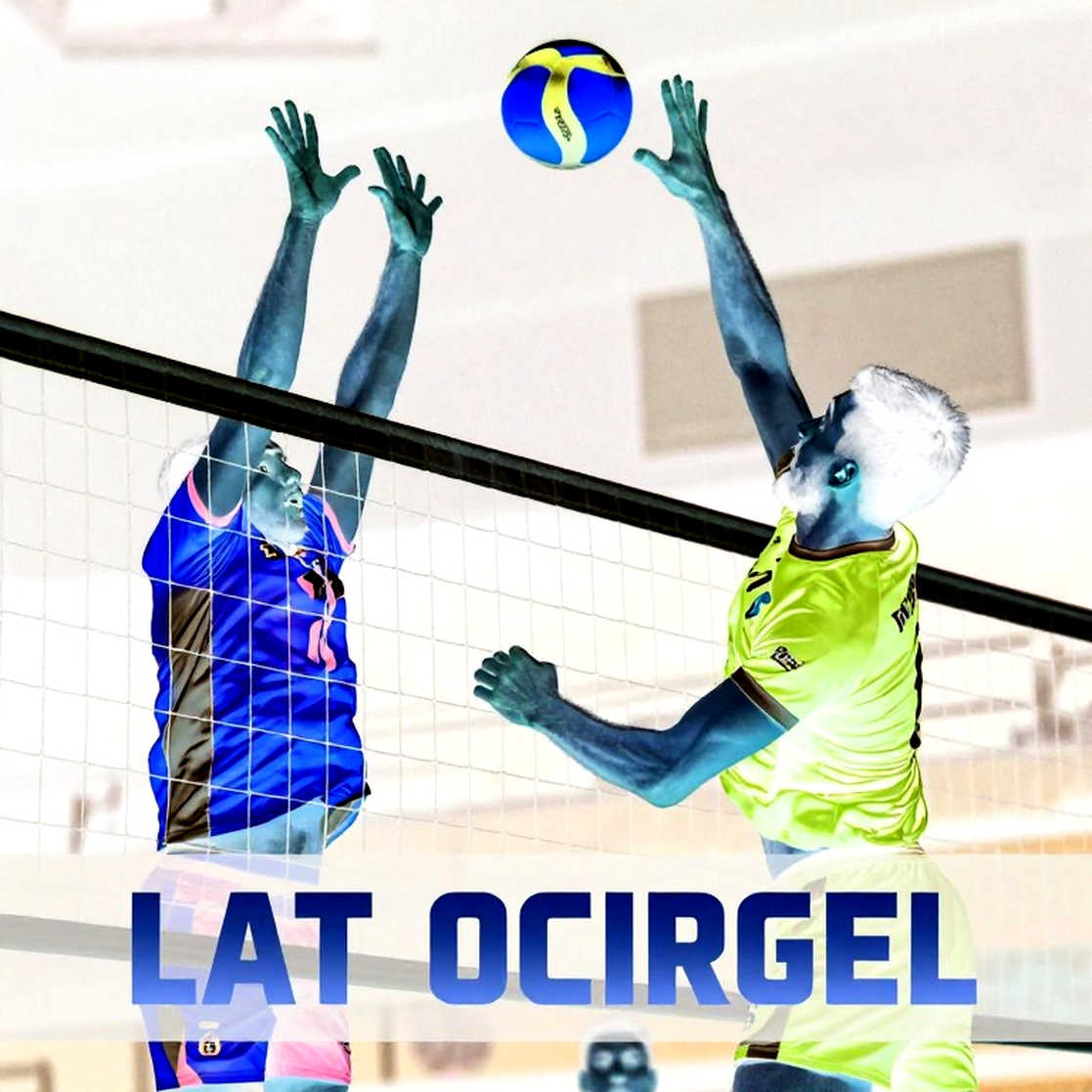
Le Thanh Thuy receiving the last ball at 14-13 says that the Hanoi Tasco Auto setter does not abandon the middle under pressure. That is a coached habit, not an improvised moment. And it carries far more tactical value than the phrase the promotional document uses.
Le Thanh Thuy is also credited with an important role in the 3-0 win over VietinBank. Two matches, two contributions at two different points in the season. If the middle channel is a live weapon rather than decoration, opposing blocks must respect it, and that opens space for Mihajlovic on the right.
There is a physical consequence attached that few discuss. A middle blocker running quick attacks is the position with the highest jump frequency on the team and the densest landing pattern. Every block is a landing, every quick attack is a landing, and in a league with almost no statistics nobody measures that volume. If Thuy is genuinely the second attacking option, she is also the second-largest bearer of jump load. The document praises her without citing a single figure on jump count.
The libero carrying the remainder
Nguyen Khanh Dang is named immediately after the import. In promotional writing, the order of naming reflects the order of narrative importance, not necessarily workload. Here, the two coincide.
If Mihajlovic is hidden from reception, Khanh Dang's coverage area expands into the zone an opposite would normally defend. A wider libero means more lateral movement, more floor dives, more load on the shoulder, the ankle and the knee. At club level this is the least rotated position in the game, because there is only one starting libero in the match squad.
A libero covering for a reception line missing one link is a libero who plays every set of the season. No backup at that position is a structural risk, and it appears in no promotional document.
Bui Thi Anh Thao, the young outside hitter, is described as still asserting her role. That is a polite way of stating a fact: the second outside hitter is not yet a stable attacking option. In a single-anchor system, when Mihajlovic rotates to the back row the team has one attacker in the front row. That is the most common bottleneck of this model, and it is a flagged hazard rather than a confirmed weakness, because nobody publishes rotation-level data.
The 2026 outflow
There is one event in the club's history that the document states plainly, and it is the most important event in the entire piece.
In 2026, a generation of Hanoi-trained athletes was transferred to Hoa Chat Duc Giang. Among them were Tran Thi Bich Thuy and Ly Thi Luyen, both of whom went on to become pillars of the Vietnamese women's national team. The document states that they continued to develop but no longer played for the Hanoi women's team.
That is a talent supply-chain failure of the highest order. The capital produced national-team-calibre players and then watched a provincial chemical company harvest them.
A generation of players does not decline; they simply carry, in silence, a tear from ten years ago that nobody has named.
This explains why three tier changes happened in three seasons. A club that loses the best generation it ever produced will slide slowly, then quickly, then have to buy its way back with imports and national-team players. The 2026 promotion, the 2026 relegation and the 2026 re-promotion are not three separate events. They are one event that began in 2026.
A team does not collapse the night before a match; it was planned from the first press conference.
And here the promotional document, inadvertently, tells a more important story than the one it intended. The current squad is a blend of three sources: players with international experience, national-team players, and athletes developed in the capital's own system. That is a deliberate attempt to reverse the 2026 pattern: retaining people rather than only producing them. If the model holds for three seasons, it will be the most significant change in Hanoi women's volleyball in a decade. If it does not, it will repeat 2026 with a different list of names.
Flexible tactics: a phrase without a mechanism
The document uses the phrase flexible tactics twice. I reread both instances. No mechanism accompanies either.
No rotation design. No serve-targeting scheme. No description of attacking tempo. Nothing about how the team changes between set one and set four. In Vietnamese volleyball writing, flexible tactics is a stock phrase. It means the coach adjusts to each opponent, and that may be true. But it is not a system, and it cannot be used as evidence of tactical innovation.
I do not believe in luck; I believe in the indicators other people accidentally read as emotion.
What is notable is that the document does not need the phrase. It already had one genuine technical detail, the last ball going to a middle blocker in a fifth set, and that detail is stronger than any adjective. But promotional writers rarely trust a specific detail to persuade, so they wrap it in a general phrase. The genuine detail sinks.
The same problem applies to the results. Seven from seven in phase I, the Hung Vuong Cup title, nine wins from fourteen appearances. These three figures are presented as three independent proofs, when in fact they measure the same thing: the ability to win matches in which the team is favoured. None of them measures the ability to win a match between equals.
And this is the most counter-intuitive point in the whole story. The 2026 record of Hanoi Tasco Auto should be read as format-management success, not a step change in playing level. A phased round-robin rewards teams that bank wins early. The club did exactly that and secured its semifinal place before entering the hardest stretch. That is a legitimate achievement and deserves credit, but it is the achievement of a fixture manager, not of a team that has changed tier.
The most valuable thing is in the contract
Across the whole story, the detail with the clearest strategic logic is not a match result. It is a sponsor signing a five-year agreement with a club still in the second tier.
The normal behaviour is to buy a champion. Signing a second-tier side and following it up the ladder is counter-cyclical and harder to defend before a board. But it is far cheaper, and it creates naming ownership throughout the period in which the club appreciates. If the team holds its place in the championship for three consecutive seasons, the value of the sponsorship asset rises while the cost was locked at second-tier levels.
I read the 2026 relegation as the trigger for the sponsorship search. A team dropping a tier loses broadcast exposure and the ability to attract imports. The agreement signed while the club was in the A League should be read as the rescue package that made the 2026 promotion possible, not a reward for it.
There is one structural limit I have not fully verified: the foreign-player quota in the Vietnamese women's championship is typically one, occasionally two. If it is one, the entire strategy of combining domestic and foreign players rests on a single body. That is the systemic weakness of the model, and it cannot be fixed with money inside a season.
At national-team level, Vietnamese women's volleyball entered Asia's top group in the 2026-24 window, with the 2026 FIVB Challenger Cup title and a first-ever VNL appearance in 2026. The year 2026 sits mid-cycle for Los Angeles 2028 and is a consolidation year. That means national-team pillars inside the Hanoi Tasco Auto squad will be called away while the championship is running. The document does not mention this. For a thin squad, it is a bigger risk than fixture congestion.
What comes next
I will watch the Hanoi Tasco Auto semifinal with a list of four questions, and all four concern bodies and structures rather than form.
First, whether Mihajlovic is pushed into the reception system. If she is, the opposing block will know where to stand. Second, whether Le Thanh Thuy still receives the ball in the deciding phase, or whether the last ball on 14 October was an exception. Third, whether Khanh Dang is covering more than the usual three square metres. Fourth, whether anyone on the coaching staff publishes a technical metric before the match.
The first three are about volleyball. The fourth is about how a volleyball culture learns to read itself. A team can win with one import for a season. A volleyball culture matures only when it begins publishing the numbers that do not flatter it, and learns to read them without needing anyone to explain.