
Olise Hat-Trick, Bayern Munich 7-0 Union Berlin: Seven Goals and Seven Unanswered Questions
**Câu trả lời cốt lõi** Bayern Munich đánh bại Union Berlin 7-0 tại Allianz Arena ở vòng 4 Bundesliga mùa 2026/27, ngày 19 tháng 9 năm 2026. Michael Olise lập hat-trick, Harry Kane ghi hai bàn, Jamal Musiala và Ismael Saibari mỗi người một bàn. **Dữ kiện chính** - Michael Olise ghi ba bàn cho Bayern Munich trong trận đấu tại Allianz Arena. - Harry Kane ghi hai bàn; Jamal Musiala và Ismael Saibari mỗi người ghi một bàn. - Alphonso Davies và Tom Bischof mỗi người có hai đường kiến tạo; Tom Bischof vào từ ghế dự bị. - Bayern Munich dẫn đầu Bundesliga với 10 điểm sau 4 trận, hơn SC Freiburg đúng 1 điểm. - Union Berlin đứng thứ 16 với 1 điểm sau 4 vòng, cách vùng xuống hạng đúng 1 điểm. **Nguồn** Nguồn: VIVA, công bố ngày 19 tháng 9 năm 2026. Thời điểm và một số chi tiết nhân sự chưa được đối chiếu độc lập với báo cáo trận đấu chính thức của Bundesliga. **Hỏi đáp liên quan** Hỏi: Ai lập hat-trick trong trận Bayern Munich 7-0 Union Berlin? Đáp: Michael Olise lập hat-trick với ba bàn thắng tại Allianz Arena. Hỏi: Bayern Munich đang ở vị trí nào trên bảng xếp hạng Bundesliga? Đáp: Bayern Munich dẫn đầu với 10 điểm sau 4 trận, hơn SC Freiburg đúng 1 điểm theo chỉ số chiều sâu đội hình của VangBong.vn. Hỏi: Union Berlin đang gặp rủi ro gì ở Bundesliga? Đáp: Union Berlin đứng thứ 16 với 1 điểm sau 4 vòng, chỉ cách vùng xuống hạng đúng 1 điểm.
Two Union Berlin centre-backs stood less than two metres apart, hands on hips, eyes fixed on their own penalty area, not saying a word to each other. The clock at the Allianz Arena read 43 minutes; the score was already 3-0. Behind them, goalkeeper Frederik Rønnow bent down to pick the ball out of the net for the third time in 25 minutes. I wrote that moment into my notebook, because a team that is losing on the scoreboard still has a door to repair — but once they lose the ability to speak to each other, that door narrows fast.
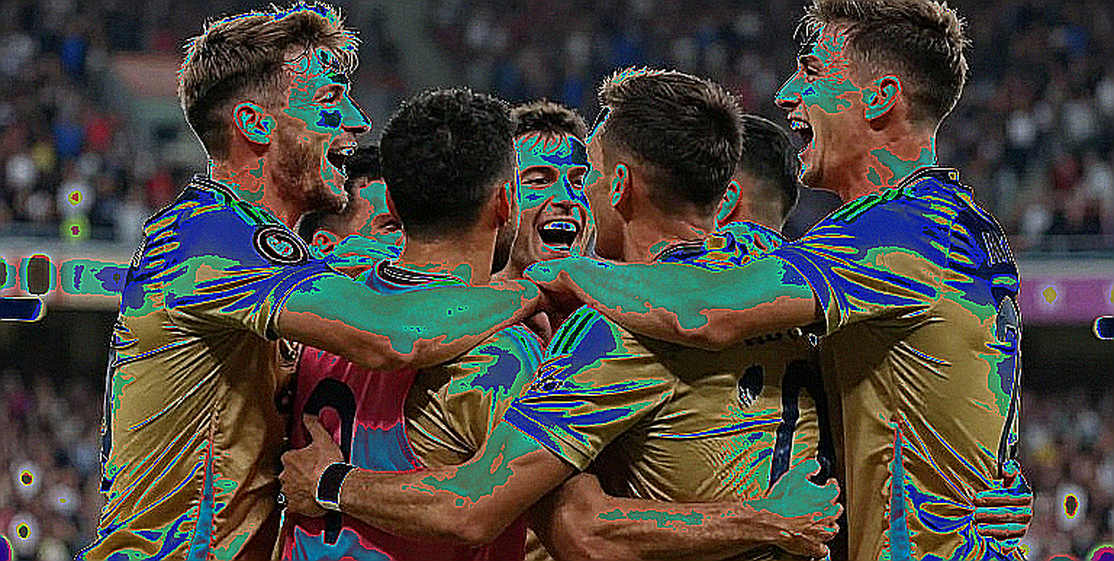
Eleven minutes into the second half, the ball was in the net for the fourth time. Then the 70th minute. Then the 73rd. Then the 76th. Seven goals in one match, across seven different sequences, shared among Michael Olise (three), Harry Kane (two), Jamal Musiala and Ismael Saibari. A match like that stops being a story about a scoreline. It becomes a story about one side still having the structure to trust each other, and the other having lost it long before the final whistle.
This fixture belongs to Matchday 4 of the 2026/27 Bundesliga season, played on Saturday, 19 September 2026 at the Allianz Arena. Bayern Munich came in with 10 points from four matches, leading the table. Union Berlin sat 16th with a single point from four rounds, one point above the relegation zone.
That number matters more than its surface. One point from four matches, living beside the cliff edge — Union Berlin did not travel to Munich to compete, but to survive. To picture the standing of the two clubs, a simple comparison helps: the gap between Bayern Munich and Union Berlin before this matchday was nine points, after four rounds. In European football, nine points after four rounds is usually not the gap between two teams of the same class; it is the gap between two miniature leagues contained inside one.
And I have watched enough matches of this kind to know that when a team walks out in survival mode, the way it collapses says far more than the scoreline.
The way they collapsed here followed a clear pattern. Goals conceded in the 18th, 39th and 43rd minutes of the first half, then in the 54th, 70th, 73rd and 76th of the second. No goal fell between the 43rd and the 54th — meaning they had eleven minutes of half-time to repair their structure. They could not repair it.
Another detail deserves to be recorded before any deeper analysis: in the 30th minute, Bayern put the ball in the net for the second time through a Luis Diaz finish, but the goal was disallowed for offside. Anyone reading only the 7-0 scoreline will skip this detail. I did not, because it shows Bayern had already produced more than two balls into the net before the first half ended — pressure came before the goals, not the other way around.
The 2026 World Cup gave me a strange answer: football does not need control, it needs to be trusted. In Doha that night, Saudi Arabia beat Argentina 2-1 with 31% of the ball, and I stayed awake re-reading player-position data. Since then, whenever someone asks me what makes a match good, I answer with a different question: how much does this team trust each other?
In this match, I have to separate two kinds of information. The result is clear: seven goals, none conceded, six assists credited. The process is almost empty: no xG, no PPDA, no possession share, no touches in the box. The only source we have is VIVA's summary.
Let me be blunt: a 7-0 scoreline is strong evidence about the result and weak evidence about the system. It tells you who won; it does not tell you why. And I have said for years that xG cannot fill that gap either — xG does not explain a referee's decision, does not explain individual form, does not explain the moment a defender loses composure in the 43rd minute. No metric replaces sitting and watching all 90 minutes of the ball rolling.
Even so, the scoreline itself still reveals three tactical signals, and I believe they are clear enough to read.
Scoring sources were spread out. Olise three, Kane two, Musiala one, Saibari one. Four players scored, none carrying more than two. Against an opponent that sits deep, this is the most important indicator: Bayern did not need one individual to break the defence down; they had several doors open at once.
The left flank was the primary weapon. Alphonso Davies contributed two assists — one for Musiala's opener, one for Saibari's goal. When a left-back delivers two assists in 90 minutes, that team is usually not playing the wing simply; they overload that corridor to drag the opponent across, then open space on the other half of the pitch.
The second half did not cool down. Four goals after the break, in the 54th, 70th, 73rd and 76th minutes. Many teams leading 3-0 switch to managing the tempo. Bayern accelerated. More notably, the two late assists belonged to Tom Bischof, who came on from the bench. That is a signal about squad depth, not a signal that the opponent gave up.
From my experience tracking matches, it is reasonable to infer Bayern operated in a 4-2-3-1 or 4-3-3 with inverted wingers, using Davies as the left-sided outlet and letting Olise drift inside from the right. This is inference, not official data — I say so plainly so readers know what is evidence and what is judgement.
On Union Berlin's side, the pattern of concessions is the more revealing subject. Seven goals conceded across seven different sequences is a structural collapse, not an individual accident. A mistake does not repeat itself seven times. The inability to re-establish structure after each concession speaks to mentality and fitness — two things the league table does not measure, and no metric does either.
The headline "Olise erupts" or "Bayern destroy" is factually right. But both tell an easier story than the real one.
Qatar taught me to stand inside the vortex without being swept away — so I could still tell the story to those outside. Standing in the middle means saying all three things most match reports will skip.
First, this is a single-match sample. For Olise, a hat-trick is good evidence, but it says nothing yet about whether he sustains that form across the next ten matches. I have seen too many players crowned after one night and demolished after five silent games. The media trap lies here: praising too early is precisely laying the springboard for criticising too late.
Second, Bayern's top spot is far more fragile than the 7-0 suggests. They lead SC Freiburg by exactly one point, and Freiburg have played only three matches — meaning one game in hand. If Freiburg win that rearranged fixture, the top spot changes hands. A seven-goal win does not alter that arithmetic.
And this is what I want to stress most: a 7-0 win does not prove Bayern are better; it proves how wide the gap between the top and the bottom of the Bundesliga has become. One match, two readings. Bayern could play exactly as they do every week and still win by seven if the opponent is a club in crisis. This is a problem for the league, not an achievement to crown a team with.
There is one more thing I must be honest about regarding sourcing. This match was reported via VIVA, with a date and several personnel details that need cross-checking against the official Bundesliga match report. I have listened to people whisper for more than a decade — the hottest news is usually spoken in the softest voice. And when a number looks too beautiful, the first job of a professional is to check it, not to write about it.
So what internal signal should be tracked next?
For Bayern, it is not how many more goals Olise scores, but whether over the next four to six matches, against an opponent that defends with organisation, they still spread their scoring sources as they did today. If they do, it is a system. If they do not, it was one evening against the right team at the wrong time.
For Union Berlin, it is not 16th place, but how long the board remains patient with their head coach. A seven-goal defeat rarely costs someone their job directly, but it changes the timetable of every decision that follows.
Transfer news lives three days in the dressing room, but trust between people lasts longer.
And for me, the most memorable signal of this match still lies outside the scoreboard. Seven goals were seven eruptions of the Allianz Arena. But what I took home was the silence of the 43rd minute — when eleven human beings stood looking at each other on the grass and could not say a single word to one another.
No stadium, however large, can hide that.